TIL: Fast Array Accumulation in Xarray
I’m working on a project1 that requires splitting a large raster into a few thousand overlapping chunks and iteratively processing and accumulating each result into an output raster. After finding my naive Xarray implementation for accumulating results was painfully slow, I decided to spend some time benchmarking different approaches. Below, I go through three different strategies that ultimately reduced processing time from a couple hours to a few minutes.
Using an Outer Arithmetic Join
By default, adding together two DataArray objects with different coordinates computes the sum of their intersection rather than their union; the output will have the extent of the smaller raster.
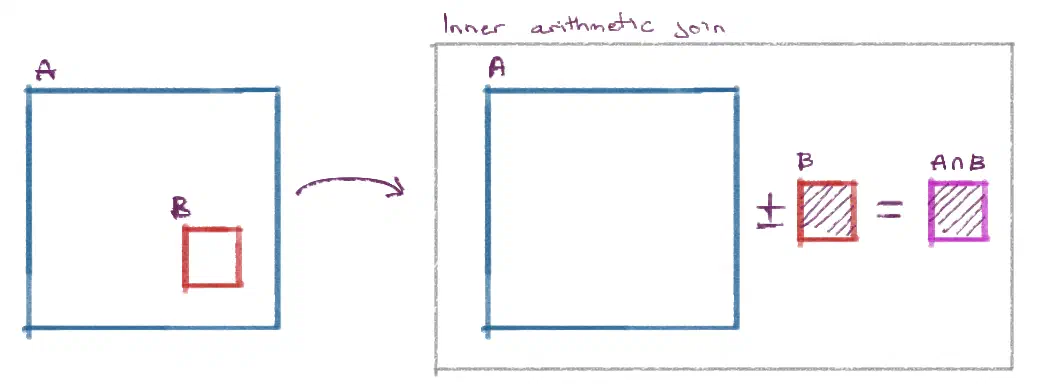
You can configure Xarray to perform outer arithmetic joins, but that reveals another snag. For some complicated reasons, Xarray doesn’t support automatic alignment with in-place operations, meaning that you need to create a full copy of the large output raster every iteration.
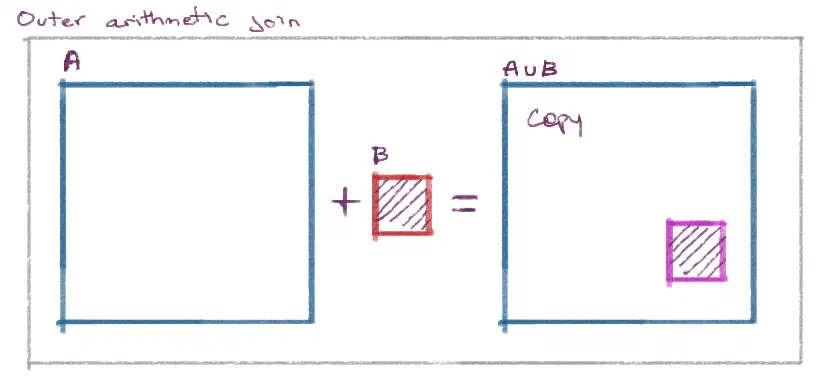
Benchmarking this with some small test arrays proved that the copy operation is pretty slow:
%%timeit

with xr.set_options(arithmetic_join="outer"):
  A = A + B
Time: 102 ms ± 2.16 ms
Reindexing the Small Array
If we can’t do fast in-place addition with automatic alignment, let’s instead try to manually align the small array to match the large array with reindex_like. By padding the small array with zeros, this approach enables in-place addition, but with the cost of a lot of unnecessary allocation.
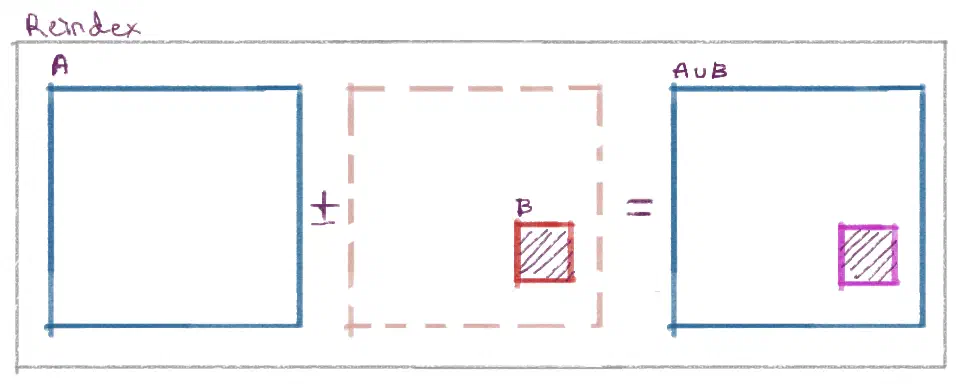
The result is faster, but it’s not fast:
%%timeit

A += B.reindex_like(A)
Time: 63.3 ms ± 284 µs
Indexing the Big Array
Instead of growing the small array to match the big array, what if we just grabbed the overlapping chunk of data from the big array and modified that in-place?
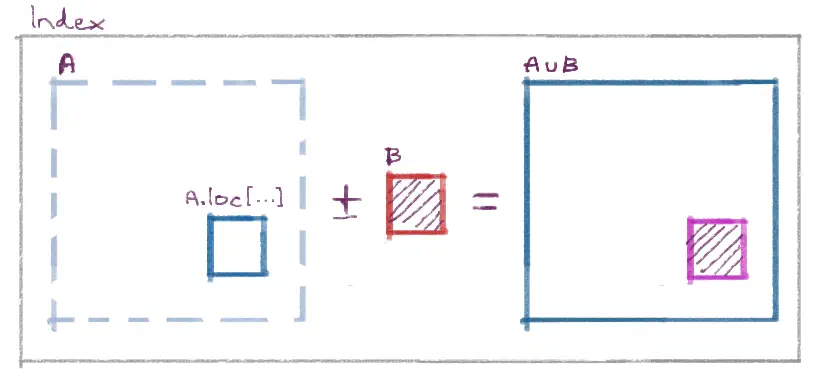
This avoids expensive copying or reindexing, providing the fastest solution by far:
%%timeit

A.loc[dict(x=B.x, y=B.y)].data += B.data
Time: 14.5 ms ± 212 µs
There’s just one problem…
Copies and Views
After updating my original code to use the optimized indexing approach, I reran my processing and was psyched to see it complete about 40x faster2. Unfortunately, the accumulated result was empty.
After a little head-scratching, I found the culprit in the Xarray docs (emphasis added):
- Label-based indexing with only slices returns a view.
- Label-based indexing with arrays returns a copy.
By indexing the large raster with the coordinate arrays of the small raster, I ended up mutating copies of the large raster instead of views. Switching to slices is a little more verbose, but fixes the bug while keeping the speedup.
# Create slices describing the extent (inclusive) of the small raster
x_slice = slice(B.x.min().item(), B.x.max().item() + 1)
y_slice = slice(B.y.max().item() + 1, B.y.min().item())

A.loc[dict(x=x_slice, y=y_slice)].data += B.data
Lesson learned.
I’m processing viewsheds around a collection of points by extracting chunks from a huge 30m DEM. Each chunk gets moved to the GPU where the viewshed can be calculated with xarray-spatial, then gets moved back to the CPU and added to an output raster that tracks how many points are visible from any given location. I’ll probably do a more detailed write-up of the project later. ↩︎
The speed improvement scaled with the dataset size, so the small-scale benchmark actually underestimated the eventual speedup. ↩︎