TIL: How Fast is Solar Bitflip Sort?
Solar Bitflip Sort is a joke sorting algorithm that relies on cosmic particles colliding with transistors in a memory node to randomly flip an array of bits into a miraculously sorted arrangement. But how long would it actually take to sort an array?
A 1996 study by IBM found that their machines experienced about 1 bit flip per 256 MB of RAM per month, or $5.5 * 10^{-9}$ flips per bit per year. To calculate sorting time, we just need to figure out how many random flips it should take to sort a given array of bits.
The Theory
If we consider two arrays of $n$ bits $A$ and $B$, the difference between the current and sorted states is just the number of mismatched bits $d$, i.e. the bitwise XOR or Hamming distance. Each random flip can increase or decrease $d$ by 1, with the probability determined by the number of currently sorted bits. Since each bit theoretically has the same chance of being flipped, the probability of reducing distance by 1 is just the proportion of unsorted bits $d/n$, while the probability of increasing distance is the inverse $(n - d)/n$.
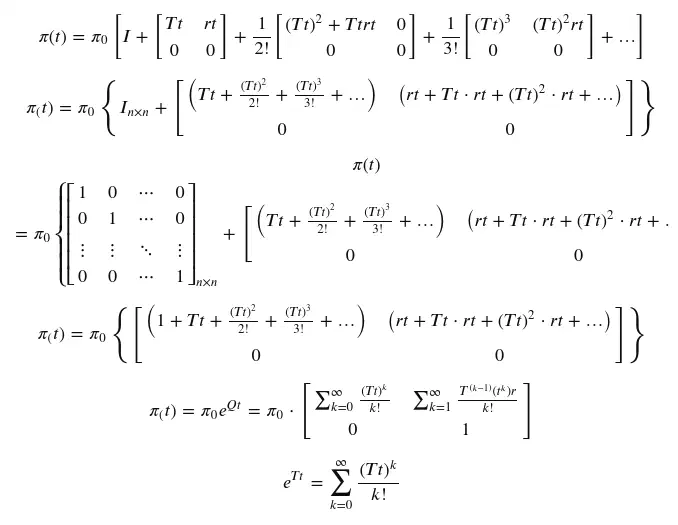
We can think of this as estimating the hitting time of a random walk in Hamming space, which should be solvable with Markov chains. Let’s just look up some equations and…
Let’s do a simulation instead!
The Simulation
To come up with an empirical estimate of required flips, we just need a function that iteratively flips the bits of a random initial state until it reaches a sorted target state. To keep things fast, I wrote this up in Rust.
use rand::{rngs::ThreadRng, Rng};

/// Flip a random bit in a vector in-place
fn flip_random_bit(state: &mut[u8], rng: &mut ThreadRng) {
    let idx = rng.random_range(0..state.len());
    state[idx] ^= 1;
}

/// Simulate the number of random flips needed to sort `n` bits once from a random state
fn count_flips_until_sorted(n_bits: usize) -> usize {
    let rng = &mut rand::rng();

    // Initialize random start and target states
    let mut state: Vec<u8> = (0..n_bits).map(|_| rng.random_range(0..=1)).collect();
    let target: Vec<u8> = (0..n_bits).map(|_| rng.random_range(0..=1)).collect();

    // Avoid starting with a sorted state
    if state == target {
        flip_random_bit(&mut state, rng);
    }

    // Flip bits until the state matches the target
    let mut flips = 0;
    while state != target {
        flip_random_bit(&mut state, rng);
        flips += 1;
    }

    flips
}
Running that function 10 million times with an array of 8 bits gives us a sorted byte after an average of 302 flips1. How long will it take to flip those 302 bits? Based on the IBM numbers with 8 bits of data, we can expect $4.4 * 10^{-8}$ flips per year, giving us an average sorting time of 6.8 billion years. With the current age of the universe estimated at 13.8 billion years, that’s doable!
While the simulation includes some lucky runs where we started with a nearly-sorted state, the initial state doesn’t actually matter that much – a worst-case scenario shuffle where the initial state is the inverse of the target only increases the average required flips to 312. ↩︎